Standing Up for Minneapolis

By R.T. Rybak
About half an hour after Renee Good was killed, I was near the scene, expecting the worst.
ICE agents were strutting back and forth with what appeared to be arrogant disregard, and the enraged crowd was becoming more hostile.
One person was already dead. I feared there would be more. My head was filled with images of the massive fires and chaos after George Floyd was murdered.
Like the rest of the crowd, I was furious. ICE and the Trump administration had already shown so much contempt for Minneapolis and our collective value of standing with our neighbors. Now this.
As I drove back to our offices at the Minneapolis Foundation, where our team was already discussing how to respond, I quickly realized this would be very different from our work after George Floyd’s murder. That death was a shock to an outraged, unprepared community, setting off a pitched battle inside Minneapolis over our police department’s racist history and how far we should go on reform. Even against that backdrop, our Foundation team did extraordinary work—delivering tens of millions to small business owners for rebuilding, funding research to help city leaders prepare for consent decrees, moving many of our fundholders to support ongoing community-building and safety reforms, and helping to launch the Groundbreak Initiative.
Now, with the ICE surge, the outrage was the same, but significant groundwork had been done. Learning from ICE responses in other cities, the Foundation itself had also made changes that made us better able to respond.
For many months—as massive federal cuts were hitting home and ICE activity was ramping up—we had been listening to our community partners to hear what they needed. We had also joined unprecedented coalitions of local and national foundations, which allowed us to compare notes with organizations across the country.
Among many lessons, we learned the critical importance of capacity building for community organizations that have deep relationships with the people hurt most by safety-net cuts and ICE’s random attacks on immigrants. The funding we and other partners provided to these groups helped them set up food deliveries and observer training for about 40,000 people. While so much of Minnesota’s extraordinary response was based on individuals stepping up on their own, these deeply rooted local organizations formed a behind-the-scenes backbone built on trust. Recognizing those closest to the community know which groups are most effective, we also supported the creation of the Latine Fund, which is led by a broad coalition of Latine philanthropic leaders who went on to set up an important rapid response fund that raised nearly $14 million to support Minnesotans affected by the ICE surge.
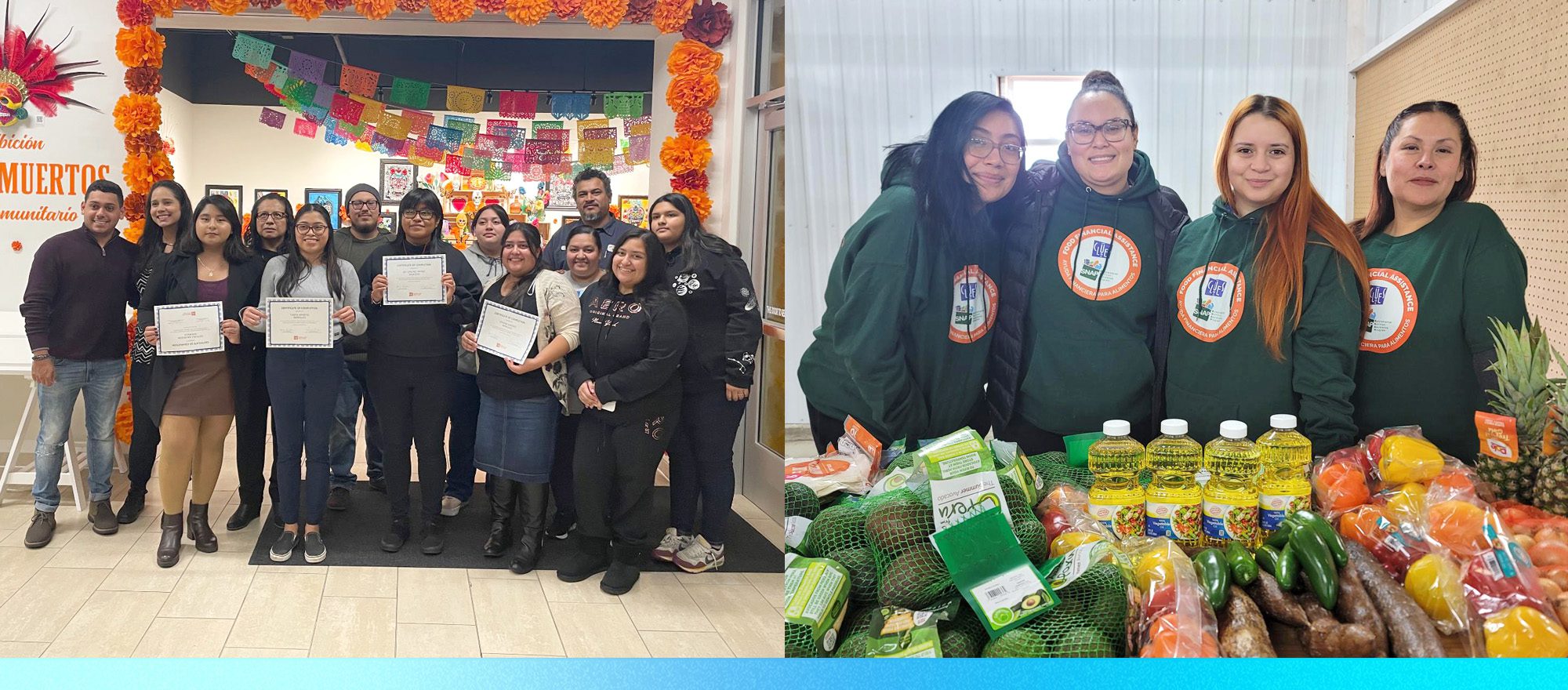
Photos courtesy of OneMPLS grantee Comunidades Latinas Unidas En Servicio (CLUES)
When Operation Metro Surge began, we turned to direct humanitarian relief. Through our OneMPLS Fund, we have now distributed more than $2.8 million for food and housing support to organizations helping communities disproportionately experiencing fear, hardship, and disruption.
It also became clear that small businesses, especially those with immigrant workers and customers, were suffering deep losses because so many people were afraid to leave their homes. This led us to partner on two funds:
The Economic Response Fund was created in the days after Alex Pretti’s murder, when we rallied local CEOs and more than 35 large companies to contribute $4 million for small business. Our nonprofit community development partners are now getting that money into the hands of restaurants and other small businesses.
The Salt Cure Restaurant Recovery Fund was started by Stephanie March, an Editor at Large and former Food and Dining Editor at Mpls.St.Paul Magazine. We partnered with her, providing philanthropic tools to support fund promotion and grant administration. To date that fund has raised $1.2 million, which is now being distributed by an advisory committee with deep expertise in restaurants.
These efforts happened while events unfolded and changed by the minute, and other partners were taking their own important actions. To help our community get a better understanding of where help was most needed, the Minneapolis Foundation funded a mapping effort at the Minnesota Council on Foundations to show where charitable dollars were flowing and where the biggest gaps were.
All this work was made easier and more effective because of changes we have made at the Foundation over the last few years:
- We moved from one annual grant round to year-round grantmaking that allows us to respond quickly to immediate community needs.
- We have continued our evolution “from grantmaker to changemaker,” expanding our work beyond grants to increasingly use levers such as advocacy, research, convening, and more.
- We have deepened our relationships with those whose Donor Advised Funds we hold, more actively encouraging them to get more charitable funds into the community and, as our ad campaign says, “stop sitting on your assets.”
During the height of the ICE surge, our most tangible work focused on humanitarian, economic, and organizational relief. However, we also learned after George Floyd’s murder that the community needs safe, peaceful settings to express their anger. Also, when your community is suddenly in the world’s spotlight, it’s difficult to communicate what’s actually happening on the ground.

Photo from Kaleidoscope of Love by Christopher Lutter-Gardella
For these reasons, we also were active in an area we loosely call “Common Ground.”
One part of that was to lift the inspiring ways so many people in our diverse community have come together to stand with our neighbors. An early example: In December, we collaborated with the McKnight Foundation and Rabbi Marcia Zimmerman to produce a video in which faith leaders across traditions affirmed their shared values of diversity and inclusion.
Another important part of this work was to support community efforts to create safe places for Minnesotans to peacefully gather for support and inspiration. These have included a moving Native-led memorial for Renee Good, the Dropkick Murphys’ concert near Alex Pretti’s memorial, and artist Christopher Lutter-Gardella’s extraordinary tribute to community solidarity, featuring 1,000 volunteers forming a massive butterfly with a beating heart.
Peaceful, creative gatherings like these have helped spotlight the heroism of Minnesotans, showing the world that our state—and especially Minneapolis—is a place where neighbors stand together.
In recent months, I have also had to ask myself some tough questions about what role I could play in speaking publicly about the ICE surge. It can be complicated to navigate my roles as a lifelong Minneapolis resident, former mayor, former news reporter, and current foundation CEO. In this case, I felt I had to be more visible and became more active in rallying the community; making a strong case that peaceful protest was essential; and, most of all, understanding that the most powerful work would be done not by institutions or leaders, but by individual Minnesotans showing up for each other in countless ways.
I so want to end this by saying we are past the crisis. We are absolutely not. ICE remains, and there is every reason to believe there are more threats to come. And the long-lasting effects of what happened will remain.
Through it all I can say three things:
- This is one of the worst things I’ve ever seen the federal government do to one of its own cities.
- I have never been prouder of the way our community has responded.
- And I have never been prouder of the team at the Minneapolis Foundation.
—
R.T. RYBAK
President & CEO